
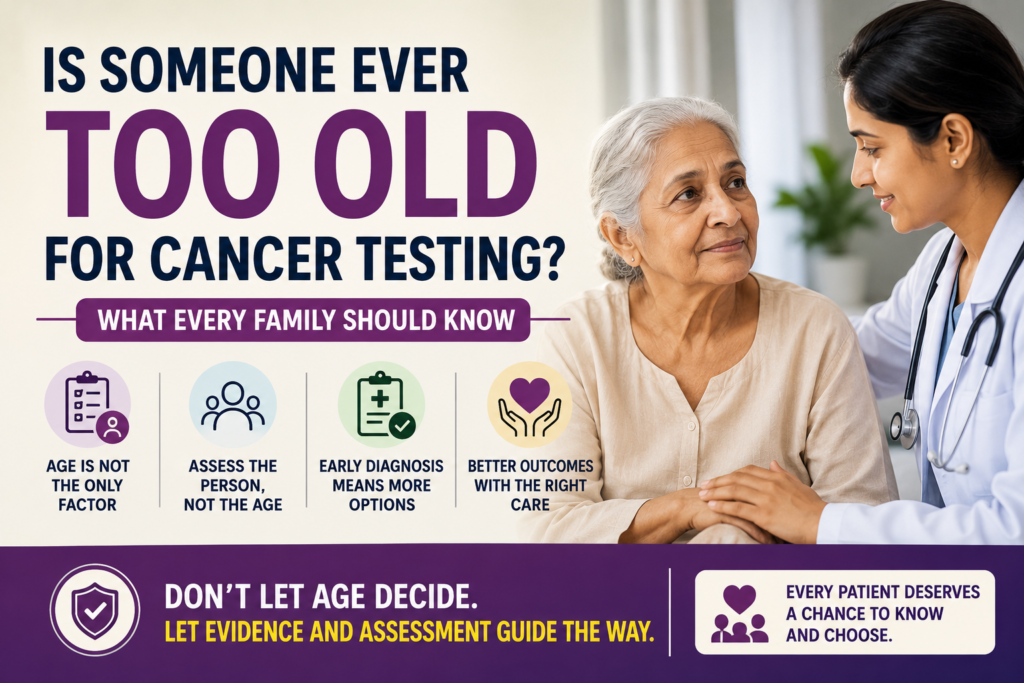
Age Is Not a Reason to Skip Cancer Testing
Bottom line: An older relative should complete the same diagnostic workup as anyone else with a cancer symptom. Age alone does not predict how a person will tolerate treatment — a proper geriatric assessment does. Skipping workup because of age results in later-stage diagnosis and worse outcomes, not a kinder path.
Why families hesitate
Caregivers often assume:
- “They’re too old to survive chemotherapy anyway.”
- “Why put them through tests and biopsies at this age.”
- “Let’s not tell them and just keep them comfortable.”
This comes from care, not neglect. But it is based on a false premise: that chronological age determines fitness for treatment.
What actually predicts treatment tolerance
Age in years is a poor predictor of outcome. What predicts it is a Comprehensive Geriatric Assessment (CGA) — function, comorbidity, cognition, nutrition, and social support — not the number on a birth certificate.
The CARG (Cancer and Aging Research Group) toxicity score and CRASH score use these domains, not age, to predict chemotherapy toxicity risk in patients over 65. A fit 78-year-old often tolerates standard-dose chemotherapy better than a frail 68-year-old with multiple comorbidities.
What the evidence shows
- Older patients enrolled in geriatric oncology trials who received geriatric-assessment-guided care had fewer grade 3–5 toxicities without a loss of treatment efficacy compared with standard care.
- Undertreatment of older patients with curable cancers (breast, colorectal, lymphoma) is associated with higher cancer-specific mortality, not better quality of life.
- Many “too old for surgery/chemo” assumptions predate modern options: de-escalated regimens, dose-adjusted protocols, oral agents, and less invasive surgical/radiation techniques now exist specifically for older or frailer patients — but these can only be chosen after a diagnosis is made.
Evaluation may reveal a milder path, not just aggressive treatment
Families often picture chemotherapy as the only outcome of a cancer diagnosis. In reality, the right treatment depends entirely on the type and stage of cancer — and for many older patients, it is far gentler than assumed:
- Hormone receptor–positive breast cancer: often managed with hormonal therapy alone (e.g., aromatase inhibitors), avoiding chemotherapy entirely.
- Prostate cancer, especially localized or low-risk disease: androgen deprivation therapy or active surveillance, not surgery or radiation for everyone.
- Early-stage skin cancers, some early breast or colon lesions: minor, low-morbidity surgery with no further treatment needed.
- Indolent lymphomas or early CLL: watch-and-wait, with treatment deferred until symptoms appear.
None of this can be offered without a diagnosis and staging first. Refusing workup doesn’t just risk missing aggressive disease — it also forecloses the possibility that the disease is one of the easily managed kinds.
Correcting the “cancer = sudden death” myth
Many attenders act as though a cancer diagnosis means rapid decline and unavoidable suffering. This is usually inaccurate:
- Course varies enormously by cancer type, stage, and biology. A well-differentiated, early-stage cancer may progress over years; a high-grade aggressive cancer may progress over months. These are not the same disease trajectory, and treating them as identical leads to poor decisions.
- Pain and complications are not universal or constant. Many patients live through months to years of reasonably good functional status, with symptom burden concentrated later in the illness — and modern palliative care manages this well when it occurs.
- Staging and grade give a real timeline estimate, not a guess. Tumor board and oncologist assessment can outline expected pace of disease — indolent, intermediate, or aggressive — so the family knows roughly what to expect rather than assuming the worst uniformly.
This distinction matters for decision-making: a family choosing “let’s not treat, let’s just keep them comfortable” is making a very different choice for a slow-growing, early-stage cancer than for an aggressive one — but they can only make that distinction after evaluation. Deciding to sit and watch without workup means deciding blind, not deciding wisely.
The real harm of avoiding workup
Skipping investigation does not spare the patient — it removes their choice. Without a diagnosis, the family (not the patient) ends up deciding the outcome by default, often at a stage where options have narrowed. A confirmed diagnosis does not obligate anyone to aggressive treatment; it opens the door to informed decisions, including palliative-only care if that is the right choice — but that should be a decision, not a default caused by never looking.
What to do instead
- Complete the workup — same as for any patient: imaging, biopsy, staging.
- Request a geriatric oncology assessment before assuming a patient can’t tolerate treatment.
- Separate the diagnostic decision from the treatment decision. Testing does not commit anyone to chemotherapy.
- Loop in the patient. Competent older adults have the right to know their diagnosis and choose their own path.
Key takeaway
Fear of treatment should never postpone a diagnosis. Whether a patient receives full-dose therapy, a modified regimen, or best supportive care should be decided after staging and geriatric assessment — not instead of them.